
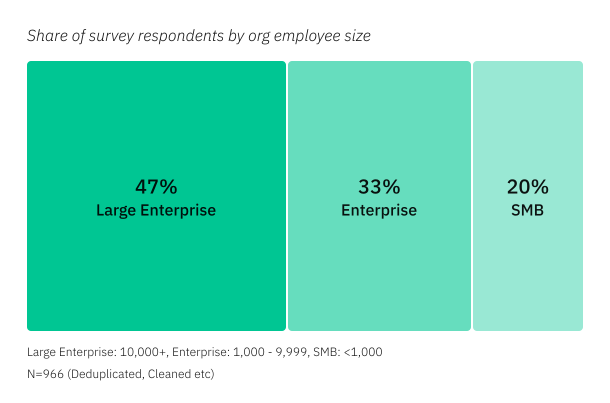
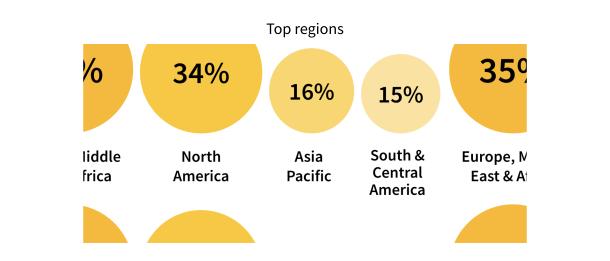
 6th annual survey since 2020
 1,192 respondents
 Representing $83bn+ in annual cloud spend
The 6th Annual State of FinOps survey is a snapshot from the global FinOps community.
FinOps has accelerated into a proactive, technology-wide discipline. AI dominates the forward-looking agenda. Scope has definitively expanded beyond cloud. And practitioners with executive alignment show 2-4x more influence over technology selection decisions.
FinOps is no longer just explaining past spend. It’s shaping future technology decisions before commitments are made. To align with this the FinOps Foundation has updated its mission from “Advancing the People who manage the Value of Cloud” to “Advancing the People who manage the Value of Technology.”
Proactive Technology Value: AI Tops the Agenda as FinOps Shifts Up, Left, and Out Across Technology Categories
1. AI Dominates the Agenda: Both Managing It and Using It
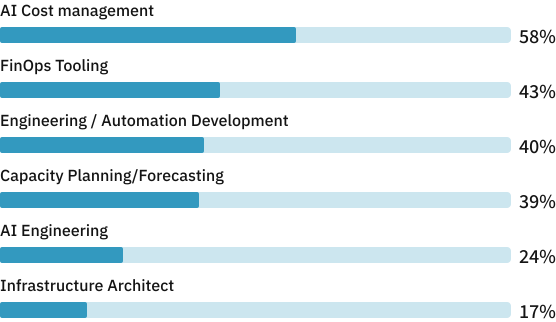
FinOps for AI is the top forward-looking priority. AI cost management is the #1 skillset that teams need to develop.
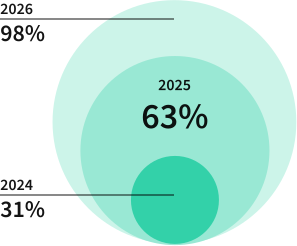
98% now manage AI spend (up from 31% two years ago). AI investment remains strong in cloud but is also increasing in SaaS, data center, and private cloud. Many organizations report being asked to self-fund AI investments through optimization savings, tying traditional FinOps work directly to strategic technology enablement.
The agenda is dual: manage AI spend and apply AI to improve FinOps team productivity and the value of AI initiatives.
2. FinOps Has Definitively Expanded Across Technology
90% now manage SaaS or plan to in the coming year (up 25%), 64% manage licensing (up 15%), 57% manage private cloud (up 18%), and 48% manage data center (up 12%). An emerging 28% are including labor costs.
SaaS, licensing, data center, AI, and even labor are now common parts of the FinOps remit. This is a broad technology discipline for value.
Supporting this expansion is growing adoption of the FinOps Open Cost and Usage Specification (FOCUS), as practitioners seek consistent, unified cost and usage data across an increasingly complex technology landscape. Demand continues for more providers and services to support the specification. Top expansion requests: AI workloads, data center, and broader SaaS/PaaS support.
3. Optimization is Table Stakes, Value is the Goal
Workload optimization and waste reduction remain a current priority for many, but the landscape is shifting. Collectively, Scopes expansion, Governance/Policy, Organizational Alignment, and Forecasting outweigh optimization alone.
Practitioners report diminishing returns in cloud optimization: “We have hit the ‘big rocks’ of waste and now face a high volume of smaller opportunities that require more effort to capture.”
As practitioners expand into more technology types, they will need to learn how to begin new optimization cycles in each technology category, while maintaining cloud efficiency.
Mature practices focus on value capabilities: unit economics, AI value quantification, and influencing technology selection. The center of gravity is spreading as teams take responsibility for increasing technology value, not just reducing technology cost.
4. FinOps Has Shifted Up
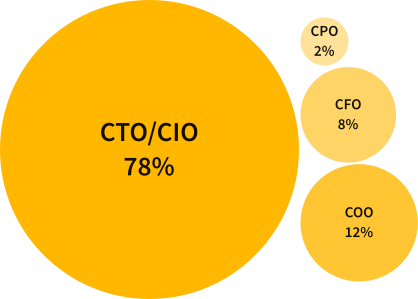
78% of teams now report to the CTO or CIO.
FinOps practitioners who are engaged with Executives are much more likely to influence technology selection: determining what technology category will drive the most value based on business strategy. Practices overwhelmingly report into the Technology organization, with a dotted line to Finance.
Those with VP/SVP/EVP/C-suite engagement (vs. Director level only) show 2-4x more influence over technology selection: cloud service selection (53% vs. 12%), cloud provider selection (47% vs. 8%), and cloud vs. data center decisions (28% vs. 6%).
FinOps leaders increasingly participate in strategic provider negotiations, multi-year investment decisions, and M&A technology due diligence. Some are influencing decisions about labor vs. AI technology investment.
5. Shift Left Is Happening, Measurement Remains Unsolved
Practitioners are embedding financial requirements earlier in the engineering and product lifecycles. Pre-deployment architecture costing emerged as a top desired tool capability.
But the measurement challenge persists: “Once you fix it, it’s gone… how do we give developers credit for shift-left activities?”
FinOps teams are engaging with Platform Engineering and Enterprise Architecture teams, building pricing calculators and offering pre-deployment guidance, but incentive structures haven’t caught up.
6. Intersecting Disciplines Are Converging
FinOps teams are collaborating most often with ITFM teams to leverage shared data, followed by ITAM/SAM to ensure asset compliance and governance, ITSM on policies, processes, and procedures, and ESG on sustainability. Platform Engineering is increasingly participating in Shift Left conversations.
Larger companies tend toward collaboration between separate teams (i.e. they have a FinOps team and an ITAM team). Smaller companies integrate them (i.e. they have a consolidated FinOps+ITAM team).
FinOps is connecting adjacent disciplines as key partners in driving technology value.
7. Small Enablement Teams with Federated Champions
The dominant operating model: centralized enablement with federated execution.
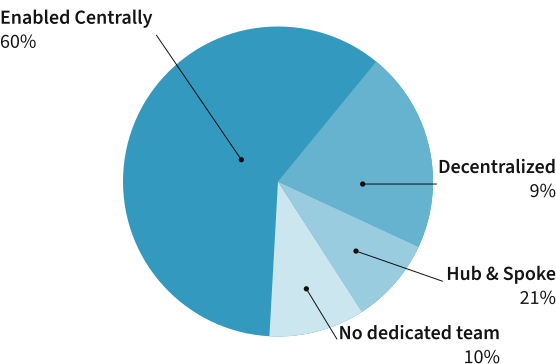
81% operate with either centralized enablement (60%) or hub-and-spoke models (21%).
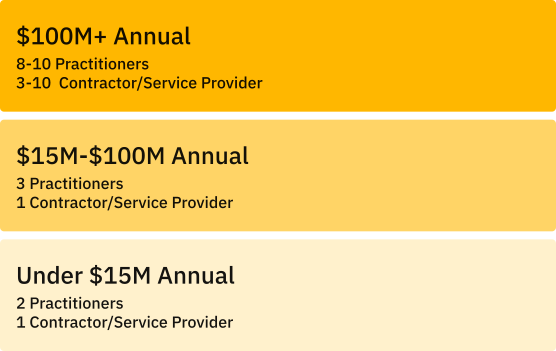
Team sizes remain lean: organizations managing $100M+ average range of 8-10 practitioners and 3-10 contractors. Successful practitioners scale through federation with embedded champions executing, plus help from AI productivity and automation rather than headcount. They don’t build large central empires.
About the State of FinOps
The State of FinOps is an annual survey conducted by the FinOps Foundation, since 2020, to collect information about key priorities, industry trends, and the direction of the FinOps practice. The survey informs a range of Foundation activities and tells the broader market how FinOps is practiced in a variety of organizations.
FinOps Has Shifted Up: Technology Value and Selection
FinOps is now firmly anchored in technology leadership, with 78% of practices reporting into the CTO/CIO organization (up 18% vs 2023 data). This signals that FinOps is increasingly viewed as a technology capability tied to architecture, engineering, and platform decisions, not just financial reporting or cost optimization. Teams reporting to the CFO declined to 8%.
The most common team structure remains centralized enablement (60%), followed by hub-and-spoke models (21%) which are more common in large enterprises. This reinforces a pattern seen across mature practices: small central teams that drive standards, tooling, and governance while enabling distributed accountability through federated champions.
This structure has strategic implications along with enablement. Those who have enabled VP/SVP/EVP/CxO+ engagement show dramatically increased influence over technology selection decisions versus those only enabling to the Director level:
- Cloud service selection: 53% vs.24%
- Cloud provider selection: 47% vs. 16%
- Cloud vs. data center placement: 28% vs. 12%
FinOps under the CTO/CIO creates stronger alignment with engineering and platform teams, enabling earlier influence on technology decisions and reinforcing the broader “shift left” trend seen throughout this year’s survey.

Where does your FinOps practice sit within your organization’s leadership structure?
Which of these best describes your current FinOps team structure?
Lean Teams: AI and Automation Skills Are in Top Demand
Even at the highest spend levels, FinOps teams remain lean.
AI cost management stands out as the single most desired skillset across organizations of all sizes—reflecting both the rapid growth of AI-related spend and the complexity of understanding and allocating those costs. Tooling expertise and automation development follow closely, signaling that FinOps is becoming more data- and engineering-driven.
The combination of small teams and specialized skill requirements reinforces why the federated model has become dominant: central teams can’t scale through headcount alone, so they scale through enablement, automation, and embedded champions.
What is the size and makeup of your FinOps Team?
Which of these skillsets are you looking to add to your FinOps practice in the next 12 months via people or tooling?
Optimization Still Important, FinOps Priorities Diversifying
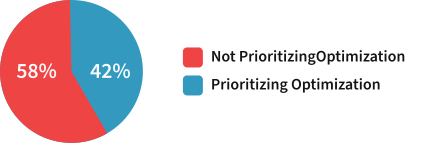
Workload optimization and waste reduction remain the single top current priority for FinOps teams. But the story is more nuanced than the headline suggests.
Year-over-year, the need to apply FinOps to more technology categories climbs significantly. When combined, priorities like expanding scope beyond cloud, governance and policy, organizational alignment, and forecasting collectively outweigh optimization alone.
Mature practitioners report diminishing returns on traditional optimization approaches. As one practitioner noted: “We have hit the ‘big rocks’ of waste and now face a high volume of smaller opportunities that require more effort to capture.” Another described reaching 97% optimization in their Cost Optimization Hub, with the remaining 3% intentionally not actioned for business reasons.
This shift suggests a maturing discipline where savings alone are no longer the end goal. FinOps is increasingly expected to guide how technology investments are planned, governed, and valued—not just how costs are reduced.


The days of finding something that's grossly misconfigured, and we're gonna save a bunch of money, or there's reserve instances we haven't purchased yet—that was years ago. I haven't been focused on optimization as priority one for a long time.
Advanced Practitioner, Large Enterprise Org
Those Prioritizing Workload Optimization and Waste Reduction vs Other Priority
Current and future priorities


AI: Front and Center in the Next 12 Months
FinOps for AI emerges as the top forward-looking priority, outpacing traditional focus areas. Respondents also rank AI for FinOps among their top future priorities, signaling a dual mindset: govern AI value while leveraging AI to improve FinOps productivity and efficiency.
Many organizations report being asked to self-fund AI investments through optimization savings—creating direct pressure to find efficiency gains that can be redirected toward AI initiatives. This “squeeze more from existing footprint to create space for AI spend” dynamic is accelerating optimization urgency even as traditional waste opportunities diminish.
Expanding FinOps into additional technologies remains a leading priority. As more technology domains fall under FinOps purview, teams are preparing to operate across a wider and more complex billing landscape.
AI Is Not Just a Large-Enterprise Concern
Across organization sizes, AI-related priorities are rising into the top tier when looking at future priorities. This signals that AI spend governance is becoming a mainstream need, not a niche or experimental effort.
FinOps Priorities for different org sizes (now and next 12-months)
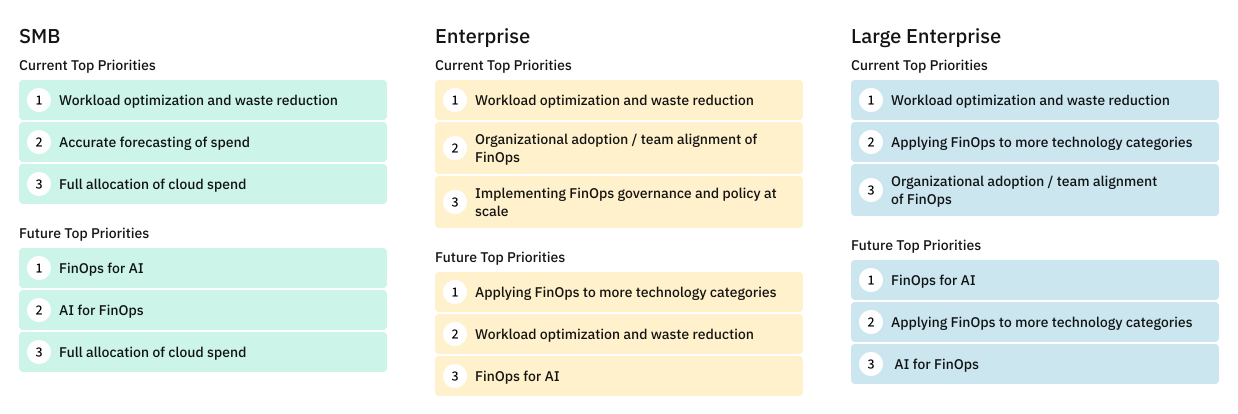
Smaller organizations balance AI alongside foundational FinOps work, while larger organizations increasingly treat AI as a dedicated domain. But the directional trend is consistent: teams across all sizes are preparing for AI-related value management.
FinOps Is a Multi-Technology Practice
What was once a cloud-focused practice is now definitively multi-technology. 90% of respondents now manage SaaS or have plans to (up from 65% in 2025), alongside licensing (64%, up 15%), private cloud (57%, up 18%), and data center (48%, up 12%). AI management has become nearly universal at 98% (up from 63%). An emerging 28% are beginning to or plan to include labor costs signaling continued expansion toward total technology value management.
Practitioners describe this evolution in phases: “First they asked us to fix cloud. Then fix the software mess. Now it’s fix the contract and license mess, now fix the data center…” referring to the progression from cloud optimization to SaaS rationalization to strategic vendor relationship management.
As purview grows, typically from leadership mandates, FinOps increasingly becomes the common language for understanding technology value across the organization. The mission has evolved from “cost of cloud” to “value of technology.”
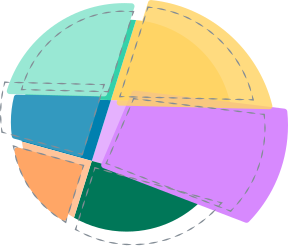
What areas of technology spend does the FinOps team manage today and in the next 12 months?
AI
98%
SaaS
90%
Licensing
64%
Private Cloud
57%
Data Center
48%
Most Managed SaaS/PaaS: Data Cloud Platforms and AI
FinOps attention is concentrating where billing volatility and growth potential are highest. Data cloud platforms and AI stand out as the most actively managed areas today (and in the near future) for SaaS/PaaS, followed by observability and security tooling.
These categories share common characteristics: rapidly scaling spend, less predictable usage patterns, and emerging pricing models that don’t yet have established optimization playbooks. AI and data platforms introduce new questions around tokens, inference costs, and value attribution that extend beyond traditional infrastructure optimization.
FinOps attention is gravitating toward the parts of the technology stack where spend is growing fastest and transparency is lowest.
Leadership identified SaaS as an area of ‘sprawl’ and that costs could really spiral out of control quickly - they tasked FinOps to come in and provide a proactive approach to managing it more effectively.
Technology Company
Which areas of technology does the FinOps team manage today, and which areas are they expected to manage in the next 12 months?
Understanding Cost Comes Before Optimizing, Whatever the Technology
Across SaaS, data center, licensing, and data cloud platforms, the most prioritized capabilities are Allocation, Forecasting, Budgeting, Planning & Estimating, and Reporting & Analytics. This shows teams focus first on understanding and structuring cost before trying to reduce it.
More advanced optimization capabilities start to appear in a change to last year’s data but are not the universal starting point. Many teams are still building the financial and data foundations needed to optimize confidently as FinOps extends into new technologies.
As one practitioner noted: “Dashboards are table stakes of yesterday—reactive. You have to move to proactive, real-time, automation.” But you can’t automate what you can’t see.
As FinOps expands into new domains, teams are applying the same maturity path they used in cloud into other technologies: first gain visibility, then build planning discipline, and only then optimize for value.
Dashboards are table stakes of yesterday—reactive. You have to move to proactive, real-time, automation.
What capabilities are your top priorities to apply to different areas of technology spend?
SaaS
Licensing
Data Center
Data Cloud Platforms
FinOps Is a Hub for Collaboration with Intersecting Disciplines
FinOps integration and collaboration continues to deepen across adjacent disciplines:
- FinOps teams are collaborating most often with ITFM teams to leverage shared data
- ITAM/SAM growth is propelled by SaaS and hybrid licensing optimization
- ITSM collaboration is shifting toward automation and remediation
- Sustainability/ESG growing engagement but low in priority, with most activity focused on external reporting requirements (collaboration highest in Europe and Asia)
- Platform Engineering is increasingly joining as FinOps shifts left into development workflows
Larger companies tend toward collaboration between separate teams; smaller companies integrate them. The varied patterns show that FinOps is not replacing adjacent disciplines but increasingly connecting them. As organizations seek a clearer view of technology value, FinOps is becoming a coordinating layer.

What other disciplines does your FinOps practice collaborate or integrate with?
FinOps Tooling Expectations Continue to Evolve
These requests reflect the increasing complexity of managing modern technology spending—and mirror where FinOps itself is expanding. As the practice evolves, tooling expectations naturally evolve with it. However, a fundamental challenge persists: How do you measure cost avoidance?
As one practitioner framed it: “Once you fix it, it’s gone. How do we give developers credit for shift-left activities?”
Proposed solutions discussed in the community include:
- Including FinOps activities in performance reviews alongside feature delivery
- Unit cost tracking at team level with chargeback reductions for high performers
- Creating separate FinOps department budgets for recognition and awards
The shift-left measurement problem remains one of the discipline’s most important unsolved challenges.
Notably, pre-deployment architecture costing emerged as a top request, reflecting the shift-left imperative. Practitioners are building internal solutions but want commercial tooling to catch up.
Open-ended responses highlight growing interest in:
Once you fix it, it's gone. How do we give developers credit for shift-left activities?
What FinOps tool features or capabilities would you like to see that do not exist today?
Top 3
-
1
Granular monitoring of AI spend (tokens, LLM requests and GPU utilization)
-
2
Shift-Left: Pre-Deployment Architecture Costing
-
3
The "Single Pane of Glass" for different technology spend
Additional themes
- Automated Remediation & "Easy Buttons"
- Technical Unit Economics & Business Value Attribution
- FOCUS adoption in tooling
- Sophisticated Forecasting & Scenario Modeling
- ITAM and FinOps: Managing software licenses
- Highlighting sustainable infrastructure alongside cost
- Granular Shared Cost & Container Allocation
Managing AI Value Becomes the Norm
98% of respondents now manage AI spend (up from 63% in 2025 and 31% in 2024). AI has moved from emerging concern to everyday FinOps scope in just two years.
The practice you have for governing public cloud spend should naturally include AI. It is simply another bucket of spend that requires the same discipline and governance as any other technology.
Financial Services
Applying FinOps to AI Introduces New Visibility and Value Challenges
Many practitioners report difficulty gaining clear visibility into AI-related usage and costs. Compared to traditional cloud services, AI workloads often have less transparent or more variable pricing.
Top challenges cited:
- Visibility into AI costs: pricing models vary widely across providers and services
- Allocating AI costs to business units: harder than traditional infrastructure
- Determining AI value/ROI: investments are often exploratory, making returns hard to define early
As one practitioner framed it: “Is your AI providing value? No one can answer that question yet.”
Practitioners are working to extend familiar principles into a new domain. AI is not rewriting FinOps, but it is testing how flexible the operational framework can become. Teams that adapt core fundamentals to AI quickly may gain an early advantage in managing this fast-growing spend area.
What challenges are you facing when applying FinOps practices to your AI spend? (multi-select)
AI Investment Is Expanding Across the Technology Portfolio
Planned investments indicate that AI is influencing multiple areas of technology rather than remaining a standalone category. This reflects how FinOps capabilities are being embedded across platforms and services.
AI is becoming a cross-cutting investment theme rather than a siloed initiative. For FinOps practitioners, this means AI value management will increasingly appear across the technology portfolio, whether they expect it or not.
AI investment is only continuing to rise but also the diversity where that investment is going, meaning additional complexity - for now the emphasis is on time to market so we are limiting guardrails not to slow down innovation and progress
Technology Company
Where is your organization planning to place its future AI investments?
AI for FinOps Is Emerging as a Productivity Lever
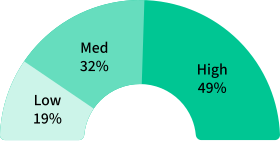
Respondents rate the importance of using AI within their FinOps practice above the midpoint on average, indicating broad recognition of its potential value. Teams focused on unit economics, managing AI spend, or operating at higher spend levels tend to rate AI for FinOps with high importance suggesting interest correlates with practice maturity and complexity.
Early use cases include:
- Anomaly detection and faster alerting
- Automated right-sizing recommendations
- Natural language querying of cost data
- Automated discount instrument procurement
- Tagging resources to speed up allocation
AI for FinOps may follow a similar path to other FinOps tooling: starting as an advantage for advanced teams before becoming standard practice. Early signals suggest AI is viewed as a capability amplifier, not a substitute for FinOps expertise.
How important is using AI for your FinOps practice?
The topmost priority right now is AI for FinOps. There is a huge emphasis within the organization on utilizing AI to drive productivity and efficiency across our teams.
Media & Gaming Company
FOCUS Adoption Grows as FinOps Expands Across Technology Categories
Year-over-year growth in FOCUS usage signals increasing interest in normalizing cost and usage data. As FinOps expands across technologies, consistent data structures are more desired as confirmed in tooling feature responses.
Respondents highlight a growing list of desired datasets, particularly across SaaS and data platforms where AI-driven services increasingly require clear cost attribution.
As FinOps scope grows, the need for consistent and comparable billing data grows with it. Specifications like FOCUS are becoming part of the infrastructure that enables FinOps at scale.
From which providers have you obtained a FOCUS-formatted billing dataset?
Practitioners Want More FOCUS Support Across Technology Categories
Top requests for FOCUS expansion center on AI, data center, and broader PaaS and SaaS support. These are the same areas where FinOps purview and complexity is growing. As organizations manage more spend in these environments, consistent cost and usage data becomes more important.
FOCUS feature requests mirror where FinOps itself is heading. As the practice broadens, expectations for standardized data across technologies naturally broaden with it.

Which area would you most like to see FOCUS expand into next?
FinOps is a Technology Value Discipline
FinOps is no longer defined by cloud cost management alone—it’s become the method for identifying and communicating technology value across AI, SaaS, licensing, private cloud, and data center throughout the organization where needed. As the practice enables technology executives and “shifts left” into earlier decision points, teams are balancing two truths at once: optimization remains essential, but the next wave of impact will come from governing and shaping spend before it happens, especially as AI investment expands and diversifies.
Underpinning this evolution is the growing role of the FinOps Open Cost and Usage Specification (FOCUS), which helps organizations normalize and analyze billing datasets across an increasingly complex technology landscape. As more providers and tools support FOCUS, practitioners gain the consistent data foundation needed to apply FinOps principles across all their areas of technology spending.
The State of FinOps 2026 data points to significant opportunities for organizations that:
- Expand FinOps into more technologies beyond public cloud
- Enable stronger executive decision-making through VP+ engagement
- Make thoughtful investments into AI—both managing it and using it
FinOps is maturing into a durable capability for managing the value of technology—one that helps organizations make faster decisions in a world where complex technology choices increasingly shape business outcomes.
Aligning to this the FinOps Foundation has updated its mission from “Advancing the People who manage the Value of Cloud” to “Advancing the People who manage the Value of Technology“.